

Rising interest rates on government debt, in the United States and other countries, were at the top of the Financial Timeshome page and many other financial news sites yesterday. Indeed, long-term interest rates in many nations have reached levels not seen since the mid-2000s, before the global financial crisis:
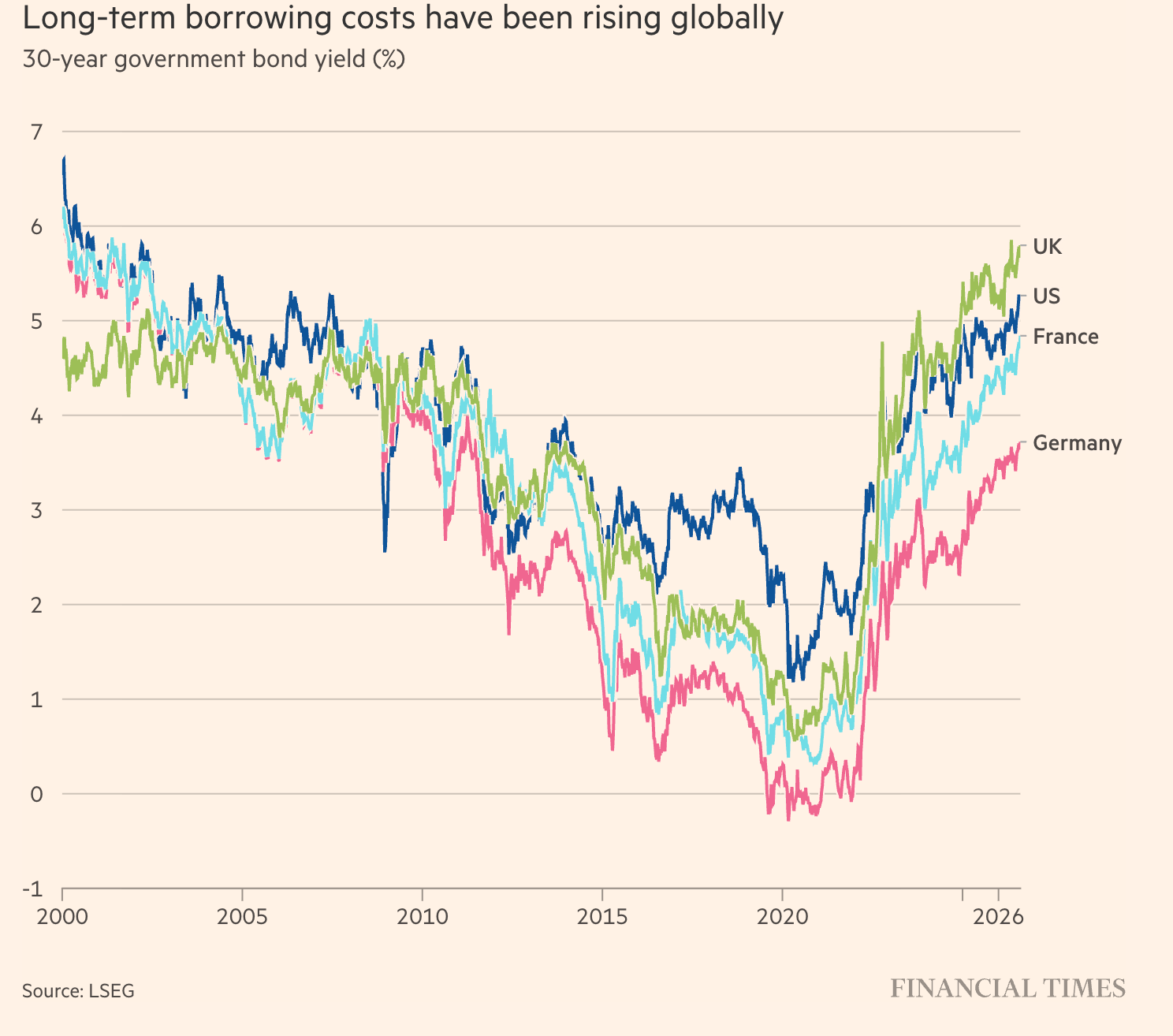
As I will explain shortly, this rate surge is partly caused by budget deficits. And the rate surge raises the cost of servicing the existing government debt, thereby making future deficits worse. It also inflicts pain on both consumers and businesses. Notably, interest rates on home mortgages and car loans are much higher than they were pre-Covid, which is bad for affordability.
But I have a message for future policymakers: Don’t panic. Don’t let the usual suspects undermine your policy agenda by scaremongering about interest rates and government debt.
I say future policymakers because in the United States there is no point in offering sensible advice to current management. Trump and co. not only won’t pay attention to sound advice, they are completely beholden to Trump’s insatiable appetite for budget-busting vanity projects. Only a future Democratic administration will be willing to act in the nation’s interest to address rising interest rates and accelerating government deficits.
I’ll talk in a subsequent post about what a hypothetical Democratic president and Congress should do. But my most important advice is not to panic. Yes, high interest rates are troubling and the next administration shouldn’t emulate the blithe unconcern of the current White House. But there’s no evidence of a looming debt crisis.
And it’s crucial that we don’t repeat the great error of 2009-2010. At that time the size of the deficit was simply not a problem. But Beltway insiders and the media confected a grand scare about debt, making it the central issue of politics and paralyzing policy responses to the nation’s real economic problems.
So let me start my discussion of today’s deficits by asking why interest rates have risen.
Interest rates on government debt can rise for two main reasons. First, they can rise because the overall demand for credit in the economy is running ahead of supply. Second, they can rise because investors demand a risk premium: they don’t trust the government to honor its debt obligations, believing that it might either default or stoke inflation in order to shrink the real value of the debt.
The following chart on US interest rate history illustrates the first case, in which interest rates rise when the overall demand for credit is ahead of supply:
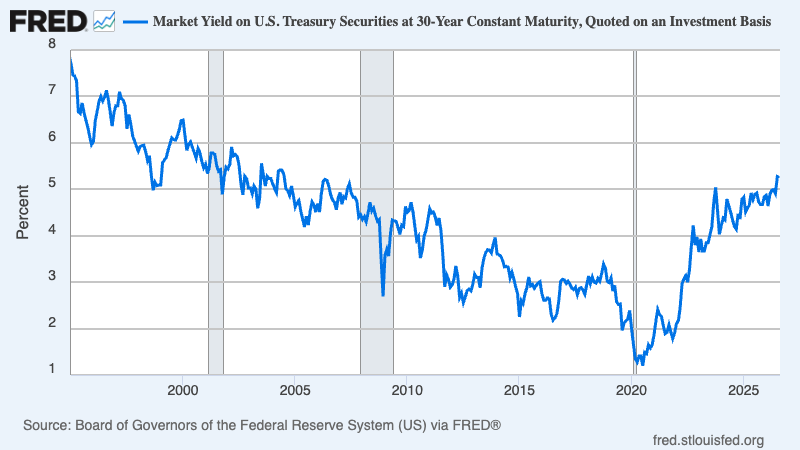
Interest rates were high in the late 1990s because there was a huge demand for funds to finance IT-related investments — dotcoms and telecoms. Rates fell after the dotcom bubble burst. The downward slide continued after the 2008 financial crisis as the demand for credit plunged in the wake of the bursting of the housing bubble.
In today’s economy there are two big sources of demand for credit. One is the AI boom, which appears to be bigger, even relative to the economy, than the IT boom of the 1990s. (Is it also a bubble? Probably, but that’s not crucial for this discussion.)
The enormous demand for credit from the AI boom is revealed by the dramatic deterioration of the cash flow position of “hyperscalers,” the handful of giant players investing massively in datacenters. Until recently, Meta, Google and Microsoft were able to pay for their AI spending out of current cash flow, owing to the huge profits they earn from their monopoly positions. Now the hyperscalers are spending so much that they are forced to sell bonds to finance their expenditures on AI.
And the hyperscalers are not the only players looking for credit. Thanks in large part to the Trump tax cuts, the government deficit is now huge. Below is a graph of the federal budget surplus (negative, because it’s a deficit) as a share of GDP. The only times over the past 35+ years the deficit has been bigger than it is now were in the aftermath of the global financial crisis and in the depths of Covid, when it made sense to run temporary large deficits:
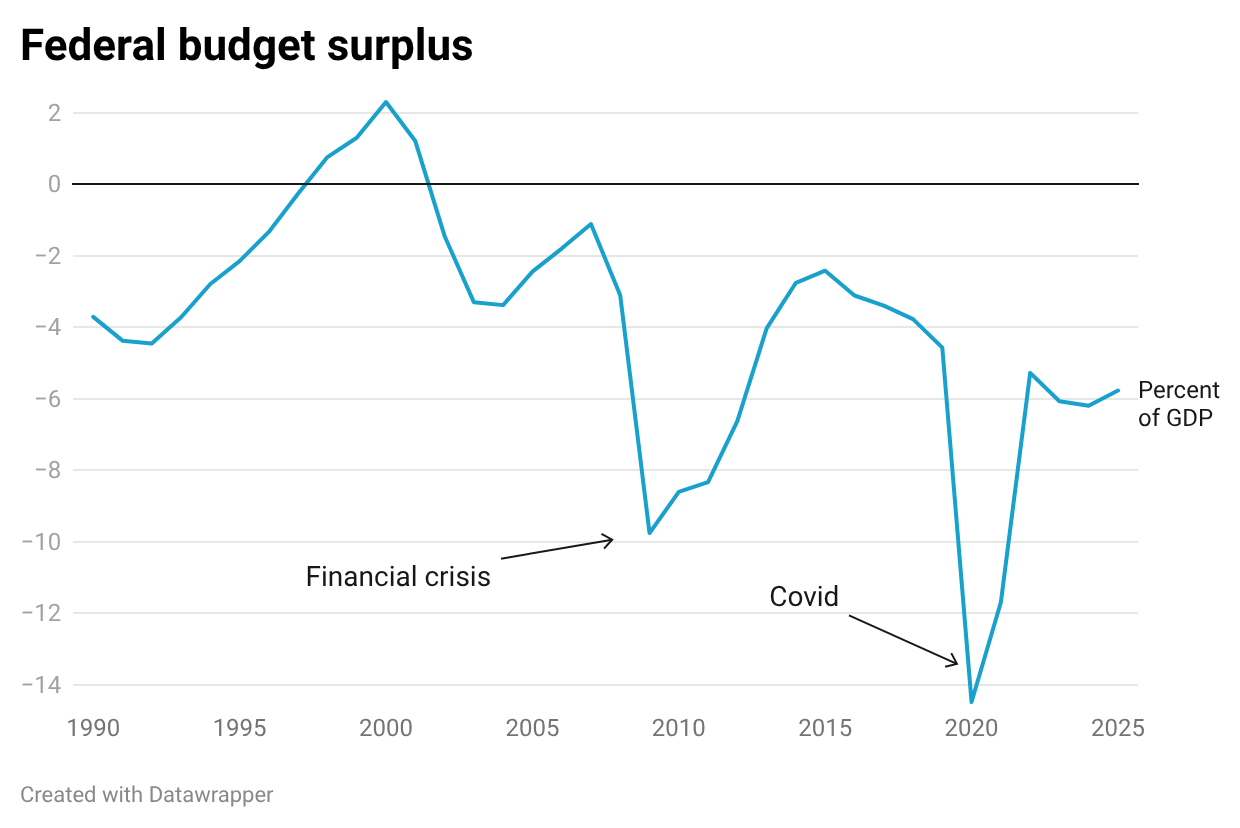
So the recent large increase in interest rates is a consequence of soaring demand for credit both to build datacenters and to cover federal deficits.
What about the second reason for a rise in the interest rates on government debt? Are fears about government solvency also driving interest rates? Interest rate spikes driven by concerns about fiscal soundness do happen. The most famous recent example is Greece:
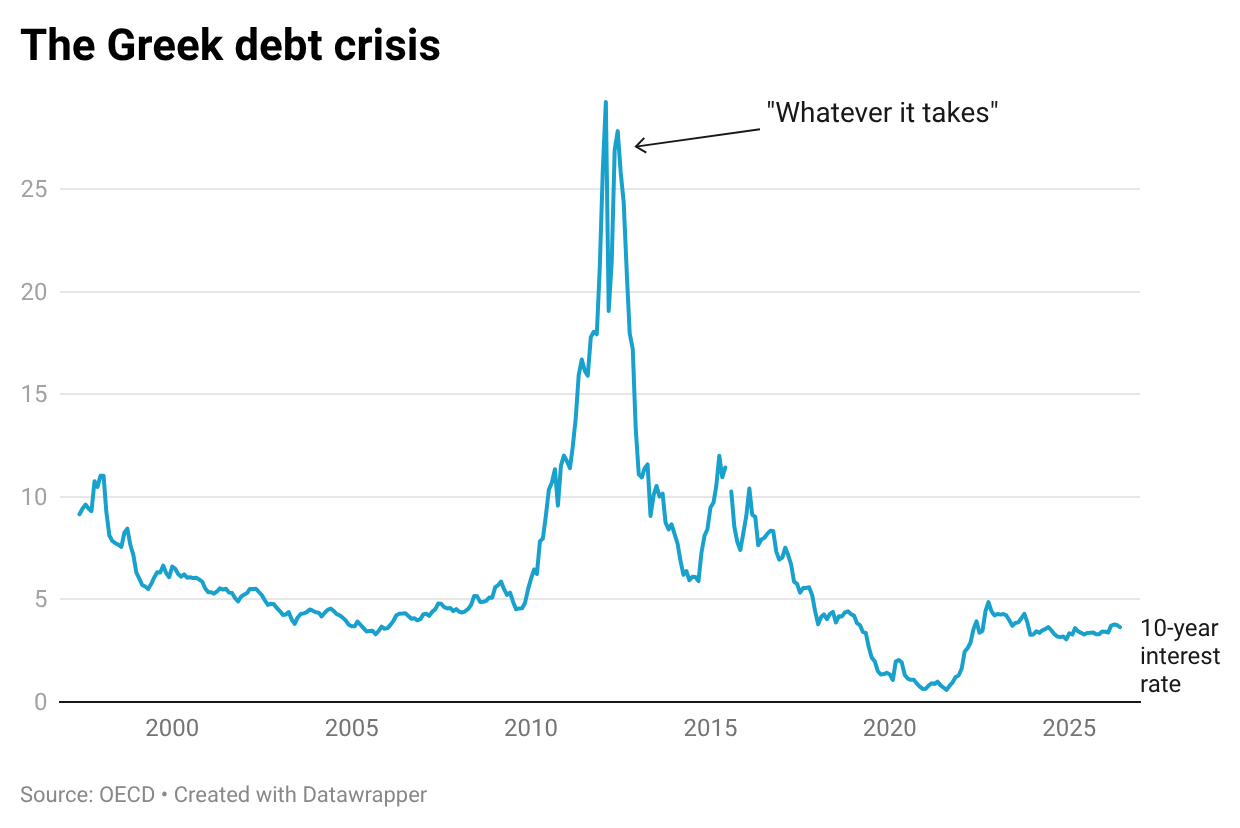
In 2010-2011, there were pervasive claims that America was about to become Greece — claims that were clearly hyped to block efforts by the Obama administration to restore full employment, invest in infrastructure, and so on. However, America wasn’t Greece then, and we aren’t now.
The truth is that even fiscally irresponsible nations very rarely have acute debt crises unless they borrow large amounts in foreign currency, because countries that borrow in their own currency can’t literally run out of money — they can print more as needed. (For more detail on how hard it is for nations with own-currency borrowing to have debt crises, see my Mundell-Fleming lecture at the IMF, back in 2013.)
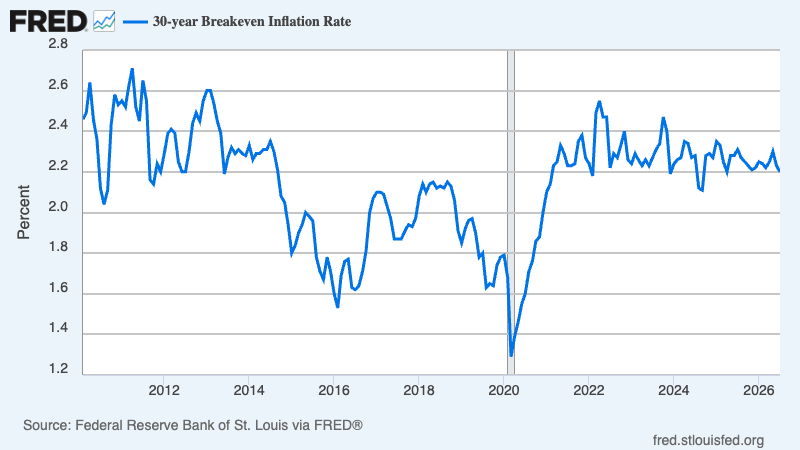
U.S. government debt is, of course, in dollars. And there is very little evidence that fears of a Greek-style crisis are driving interest rates now. For example, if markets were really worried about U.S. solvency and the potential for the government to inflate the debt away, this should be reflected in measures that track inflation. But there has been, in fact, very little change in the “breakeven” inflation rate, a measure of long-term inflation expectations:
Another indicator is the price of credit default swaps — insurance against a possible US default. These also haven’t moved much:
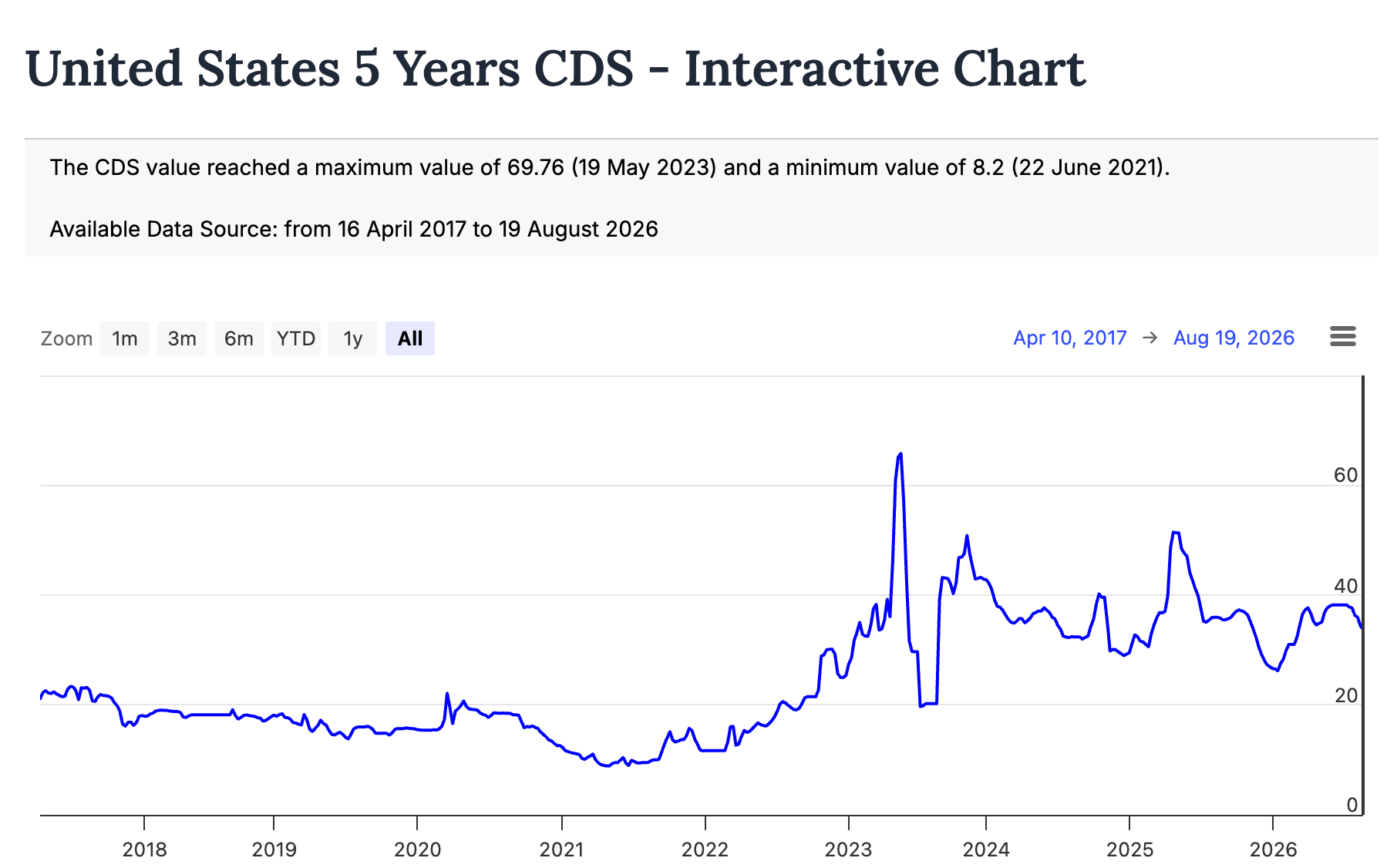
Source: World Government Bonds
Why are financial markets apparently unconcerned about U.S. solvency? Surely not because they expect Trump to act responsibly. The clear implication is that the markets expect Democrats to do what they’ve done repeatedly in the past: clean up the fiscal mess Republicans left behind.
So what should Democrats do? I’ll get to recommendations in a subsequent post. For now the key message is, don’t panic. Interest rates are up, but this is not a debt crisis.
MUSICAL CODA
The Grand Cycle:
Republicans slash taxes, increase defense spending, and balloon the deficit. All cheer and the economy craters.
Democrats are elected to fix the economy. Immediately the Number 1 top priority crisis-level concern is the DEFICIT and how it's going to devour each of us in our beds. Of course, there is one and only one way to deal with the deficit: Slash social programs. The economy begins to recover and people fell good enough to . . .
. . . vote for Republicans, who slash taxes, increase defense spending, and balloon the deficit.
Thank you for reminding me of your lessons of yesteryear: that having our own currency differentiated us from the Greeks or anyone else who had to repay debt with Euros. Keep on being right about everything!