
Talking With Robin Brooks
Trying to figure out the Hormuz shock

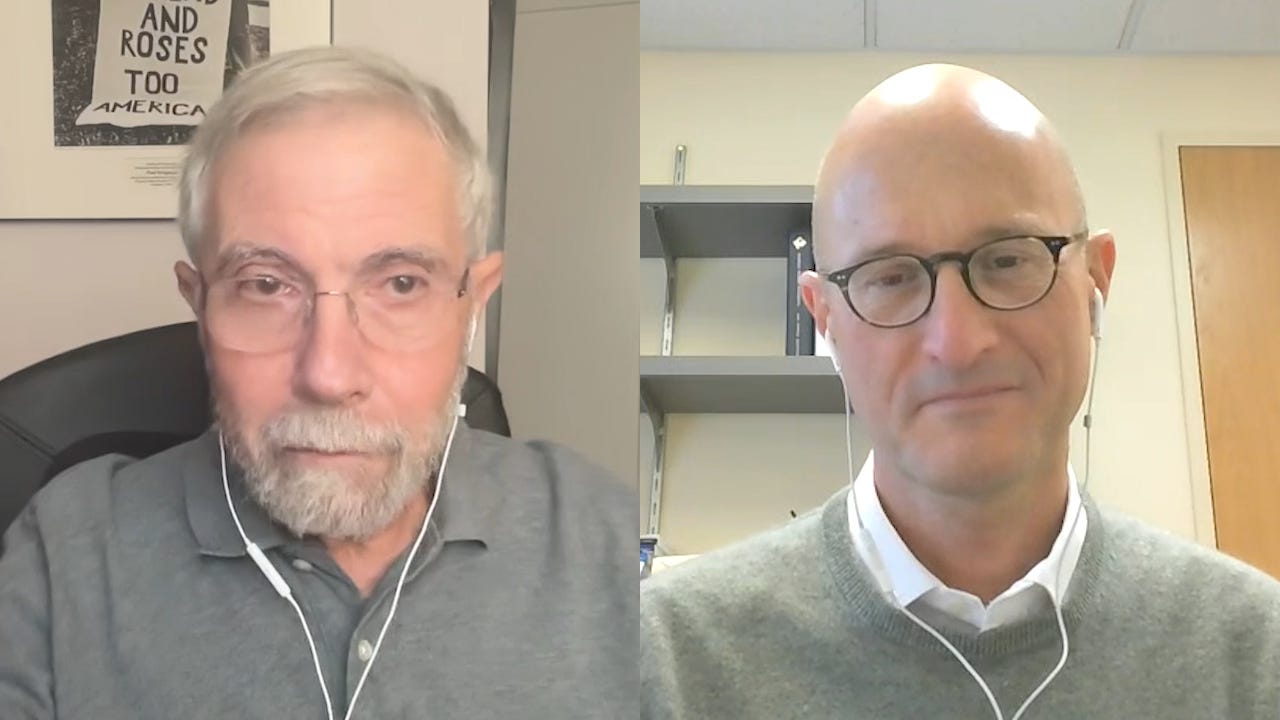
Robin J. Brooks was the chief economist at the Institute for International Finance, and before that did foreign exchange at Goldman Sachs. He’s now at Brookings, and has been doing extremely interesting work on the unfolding oil crisis — often reaching conclusions that differ with mine in enlightening ways. So we talked Thursday, hoping that our conversation wouldn’t be overtaken by events. Transcript follows:
. . .
TRANSCRIPT:
Paul Krugman in Conversation with Robin Brooks
(recorded 3/19/26)
Paul Krugman: Hi, everyone, Paul Krugman here. Interesting world out there. Interesting as in terrifying, including economically.
I’ve long been a follower of Robin Brooks, formerly chief economist at the Institute for International Finance. Before that, foreign exchange at Goldman Sachs. Now at Brookings, who’s been writing a lot about markets, but now particularly some of the most interesting, illuminating stuff I’ve been seeing about oil, some of which has been not reaching the same conclusion I did, which is good—we can have a discussion. If you’re sure that you know what’s happening then you’re almost certainly wrong.
Hi, Robin. Welcome to this conversation.
Robin Brooks: Thanks so much for having me, Paul. It’s really an honor to be talking with you. I’ve learned much of what I know about international macro from you.
Krugman: I have to say, I’m feeling young again. I was Bill Nordhaus’s research assistant in 1973 on energy economics. The project was before the Yom Kippur War and the Arab oil embargo, but played right into that. So now here we are again: energy crisis—triggered by events in the Middle East.
Let’s start with the Strait of Hormuz issue. You’ve made two really good calls so far. First, early on you warned that the markets were just underpricing the risk. Then when the markets had their first run at $120 a barrel, you said “this looks like it’s panic mode.” So why don’t you tell me what you think is happening in the markets? Of course, everything may be out of date by the time this goes up, because we’re actually talking on Thursday morning.
Brooks: So let me give you two ways of thinking about what’s going on, both of them are really about trying to think about what kind of risk premia need to be priced in oil, given all the massive uncertainty that we have. The first way that I’ve been thinking about this is—I spent a lot of time working on Ukraine and Russia and sanctions after the invasion four years ago. Russia produces about 10 million barrels of oil per day. It exports, of that, about 7 million barrels of oil per day. The Strait of Hormuz has transit of about 20 million barrels of oil per day. So the Strait of Hormuz is roughly 3 times what Russia could have been. And remember, in the days right after the invasion, markets were really worried about Russian oil being embargoed. There was a whole discussion about that. So the rise in Brent, which is the global benchmark oil price, is about 70% from two weeks before the outbreak of war in the Gulf to now. On a similar time horizon back in ‘22, it was 20%. So we have roughly a 3X in terms of the rise in oil prices. So when people come to me and say “$150 or $200 for oil prices” and we’re currently at $115, roughly, then I think, “why, what’s the rationale?”
The second perspective is on the supply shortfall that we have and using price elasticity of demand to think about: “how much does the price need to rise if demand has to do all the adjusting in the short term,” which it does. And “what kind of numbers do we come up with if we make reasonable assumptions?” So I put out a Substack note today—thank you so much for reading my Substack, I’m incredibly flattered and stressed as a result— if you assume that the Strait of Hormuz goes from 20 million barrels of oil per day to 10, it’s basically oil from the Gulf is running at half of its normal capacity, and you assume a price elasticity sort of in the middle of the range that the academic literature has, which is about 0.15, then you get that this would generate a rise in oil prices of between 60 and 70%. So again, if I think about what we’re pricing in markets now versus what basic back-of-the-envelope-calculations tell you, then I think we’re roughly in the right ballpark.
You will have seen, Paul, headlines that Saudi Arabia is using a pipeline to the Red Sea that is worth about 4 million barrels of oil per day currently. Then the Iranians are obviously exporting oil. That’s around 2 million barrels of oil per day. Give or take a few oil tankers that are run by Greek ship owners who are risk-loving, I think we’re close to the 10 million barrels of oil per day.
Krugman: 20 million barrels a day was going through the strait, and it’s really hard for anything to run through the strait. So the argument is that the Saudi pipeline to the Red Sea gets some of the oil out, and the Iranians are still getting their oil out.
Two questions. The first is: elasticity. Not everybody reading this will be an economist. So, the elasticity is if the price of oil goes up 1% by how many percent does the quantity of oil that people want to burn go down? And it’s a very small number, that we know for sure. Oil is used primarily in the US, two thirds of it is for transportation. It’s really hard for people to use less in the short run. There’s not much you can do in the short run. You got the kids who got to get picked up, you need to get to work. Maybe you can cancel your vacation, but it is really hard to not burn oil in the short run. So we’ve got a small number. It’s very, very hard to know; estimates of what that elasticity is are highly uncertain because: how would you know?
I’ve followed you through some of the literature and there’s these studies which are very ingenious, and they use very clever econometrics, which worries me! I think I noticed that the existing literature also doesn’t look at the response to the Russian invasion of Ukraine, which would sort of be the closest thing to a natural experiment we’ve had lately. But the literature is older than that.
Brooks: First of all, elasticities are incredibly hard to estimate, as you say. What we really want here—and this was a little bit of the analysis that I did early on in this shock—is conditional elasticities on shock environments that are comparable to what’s going on now. The numbers that I’m using are unconditional across large amounts of time. I think my instinct is probably the same as yours that these elasticities may be off and perhaps overstate the ability of consumers to cut back on oil consumption in the very short term, especially in an environment where getting to your job is more important than normal. I think the the bottom line is, however, about an order of magnitude and that is that if you believe that the oil price is going to $200 a barrel, then implicit in that forecast is an assumption, again, for a range of elasticities that traffic out of the Persian Gulf is close to zero. That’s the key thing.
The other thing Paul, and this is just my own navel gazing, having done lots of work on sanctions, I have generally had the impression that when there is disruption to the oil sector, there are forecasts that get trotted out that are often apocalyptic. So, for example, when the United States and its G7 allies in 2022 were working on the G7 oil price cap, there was an analyst who came out with a forecast for oil to go to $380 a barrel, which was very scary. So I may be completely wrong, but I tend to think this is a war. By the way, I don’t think it was smart to go into this confrontation at all, but this is a war that is basically being fought at the discretion of the United States and of the US president. He can walk this back at any moment. And, of course, it’s true that the Iranians can keep the Hormuz Strait closed, but they’ve also been badly battered. So I think there is a path to de-escalation too.
Krugman: Just a word back on the elasticities, I’m sure you’ve done the exercises. You have this amazing three dimensional chart. The difference between the elasticity being .15 and it being 0.1, is very large. The difference between half of the normal oil getting out of the Persian Gulf and only a third of it getting out is very large. So it’s this wildly uncertain environment. Just as of overnight—before we had this conversation—the Iranians started blowing up oil facilities and so on. I guess, in response to the Israelis having blown up some of theirs; there’s a question about, what does this do if the half that was supposed to make it out of the Persian Gulf, even with the Strait of Hormuz closed? That must be a worry.
Brooks: Let me scroll things back a little bit to the bigger picture. When I hear analysts talk about options going forward, they basically talk about an escalation scenario, which includes boots on the ground by the US and Israel, or some kind of taco where the United States declares “mission accomplished” and we believe it. I think the important thing is that there is a third option.
That option, in my opinion, is to do an embargo of Iranian oil to stop oil tankers leaving Kharg Island and other Iranian ports, and to starve the Iranian regime in that way economically, without using violence and warfare. That was the motivation behind the G7 oil price cap. That was something I was a huge fan of at the time, and I work closely with Ben Harris here at Brookings, who was one of its main architects. There were a lot of problems in enforcing something as complicated as the G7 oil price cap in the case of Russia. So I think a full embargo and a blockade here is a better way to go. It’s a viable third option, especially since, the 2 million barrels of oil per day, that is something arguably that is priced at this point.
So going back to the elasticity point that you mentioned, Paul, let’s assume point one. Then a 2 million barrels of oil per day shortfall is a 20% rise in oil prices. If we go with my .15 elasticity it’s more like 13%. In a 70% oil price rise I think some or a lot of that is priced. I’m dismayed that in the policy discussion here in Washington, that is not an option.
Krugman: So you were very much an advocate of embargoes against Russia. Which has been mostly a bust. Basically because everybody wants somebody else to cut their purchases and in general the sanctions against Russia have been incredibly porous. You’ve been on that. So are you saying that this would be different because basically the United States can physically enforce the embargo? We can just stop the ships from leaving?
Brooks: Two points. The G7 oil price cap is brilliant in theory. The idea is that the cost of extraction in places like Russia or Iran is really low. So it’s around $10, $15 a barrel max, so we can give them $30 a barrel and they still have an incentive to export. The global market doesn’t have a shortfall, so the world isn’t subject to an oil price spike. The problem with the G7 oil price cap is that, in a way, it’s shades of gray. You have lots of nuances on how you actually make sure that the Russians are being paid the cap, not more, not less. How do you ensure that they don’t build up a shadow fleet of oil tankers? Which of course, they did. So there are countless ways in which that thing was massively undercounted. The embargo is basically binomial. It’s 1 or 0. I first of all think that means either there are ships running or there aren’t.
Second, I think the US Navy has a huge presence in the region. I think if the president announced “we are going to shoot at any ship that leaves with Iranian oil.” I don’t think anyone would want to test that. So I think in principle it is something that should be at least tried.
Krugman: Do you have a sense of how cash constrained the Iranian regime is? That’s part of the question, can they just ride this out for six months or a year?
Brooks: This is a great question. I have this debate on Russia all the time. Countries like Russia and Iran have savings that they’ve built up over time. This is a stock which they can obviously run down to pay for imports and technology, things that they need to run their economy. But what determines in my mind the value of their currency—the ruble or the Iranian Rial—is what’s going on in the flow in the balance of payments every day. So Iran currently has a current account surplus of around 3.5 to 4%, I’m talking about before the hostilities.
Krugman: Right off 3 to 4% of GDP. “Current account”, for our listeners, that’s the broad definition of the trade balance. It includes services and income on investments. Iran has a surplus. Surpluses do not necessarily mean strength. I think Iran is basically like Russia, as I think you’ve been quoting, “It’s a gas station masquerading as a country.” They were running substantial surpluses before, but you’re saying that that gives them some kind of cushion.
Brooks: My only twist on the John McCain statement is that Iran is a gas station masquerading as an Islamic republic.
They have a surplus of around 3.5% of GDP. Exports of oil and gas are about 15% of GDP. Imports are about 10%. So let’s think about what happens to the current account or the balance of payments if this oil and gas number goes from 15% of GDP to zero. Basically it means that the Iranian currency will fall very sharply in value very quickly. The central bank has some reserves which it can use to slow that decline.
But basically, this will be a huge shock to inflation, to financial stability and to the purchasing power of Iranians and my best guess is that it’ll be much harder for Iran to keep fighting this war than if it didn’t face such an economic shock.
Krugman: There’s a lot of things which probably you don’t know and I don’t know. I mean, nobody knows, which is just how tough this regime is. They could have rationing and controls and exchange controls and just suffer.
Hopefully we don’t go there, although you’re saying that if we were able to do your proposal that would be one route, basically attempt extreme economic pressure. They basically have no exports other than oil. So this is how they pay for whatever it is they buy. This actually gets us to the currency stuff.
Leaving aside what happens to Iran, you’ve been writing quite a lot about how this oil shock should be affecting different currencies. Why don’t you talk about that for a bit and let me throw in some of my own questions.
Brooks: So the shock after Russia invaded Ukraine was a really big shock. What we saw four years ago was basically very similar to what we’ve seen in the past two and a half weeks. Initially, markets are unpleasantly surprised. Risk aversion rises if the oil price rises. The dollar appreciates as Americans facing an environment of greater uncertainty, repatriate assets that they had held overseas. And as foreigners flocked to U.S. assets—including U.S. treasuries—as a safe haven. That is the initial phase of the shock. As markets become more comfortable with the shock and decide this is not going to be the apocalypse, but we’re just dealing with a step up in oil prices and perhaps other commodity prices. They start to appreciate or strengthen the currencies of commodity exporting countries, and they start to weaken currencies of commodity and oil importers.
So what we saw, to give you an idea, in the first quarter of 2022, Brent rose, all in all, about 40%. The Brazilian Real rose 20%. And it was by far the star performer across emerging markets. The biggest losers were countries like Turkey (which is a big energy importer) and Japan, Korea, all the big energy and importers across Asia.
Krugman: Interesting situation here for the United States, and it’s all confounded. There’s the safe haven role of the dollar, which we’re seeing despite everything—not too much politics here—that the US has been doing. Still, that sense that where you run to if the world looks like it might be coming to an end, do you run into dollar assets?
Also, the United States is a net oil exporter, which is very, very different. I cut my teeth on energy stuff, half a century ago, but that was a very different world. Where the United States was pretty import-dependent and now net exporter. But the question that I have in this is, in a way, a counterpart of the Iranian or Russian story is how much connection does fracked oil from the Permian Basin have to the US economy more broadly? Why should it matter that some guys in Texas and Oklahoma are extracting oil and selling it, when that’s not doing any immediate good to U.S. drivers? Why should it actually have any impact on the dollar? I guess that’s a question also for places like Brazil, but I’m still trying to understand how all that works.
Brooks: So let me unpack a couple things and circle back to your question on oil and should the US benefit and therefore should the dollar go up.
There are three things going on. First, a sort of short term knee jerk risk aversion thing. Second, and it’s related to the first thing, the reserve currency status of the dollar. The third is the actual impact on the economy, whether it is net positive or net negative from higher oil prices. I hope I’m not mangling that.
So the dollar went up recently because of this knee jerk risk aversion. I have no doubt that if this war ended tomorrow we would be back to a weak dollar environment. In fact, it’s my expectation once all is said and done, that this year the dollar will fall 10%, start to finish. So I think that’s the world we live in. At the same time, as this episode is reminding us, that isn’t about reserve currency status. That status has been remarkably resilient to some pretty chaotic policies in Washington, DC. There are IMF data that surveys what reserve managers do. These are called COFER data, and they basically survey the way that reserve managers give to different currencies. So these are reserve managers, for example in China or South Korea or Japan, who have large sovereign wealth funds. The remarkable thing is that the weight of the dollar in these allocations through all of last year, through this incredible policy chaos of reciprocal tariffs and at times, market dysfunction, the weight to the dollar was completely stable. So I think it’s important to remember that these sovereign wealth managers are very slow moving. They manage huge amounts of money. And these are not people who are chasing short term trends. And so the hurdle for the dollar to lose reserve currency status is very high.
Krugman: This is official or quasi official holdings of assets in different currencies. But the dollar’s international role is a lot more than that. The foreign exchange market is basically every currency against the dollar. There’s a lot of international invoicing that’s in dollars, and those things are extremely hard to move.
Let me get your reaction, I get a lot of mail, I’m the king of hate mail. But I also get a lot of not-necessarily hate mail, a lot of people are going on about, “doesn’t this just mark the end of the dollar’s international role because countries will start to price oil in something else, in Renminbi”. I have a reaction to that, but what would be your take on that?
Brooks: I have said to those emails—and I suspect I get a fraction of the volume that you get—that this is wishful thinking. The data just doesn’t bear it out. To your point, there is a longer term decline in the weight of the dollar in these reserve holdings. But that’s kind of a secular trend that reflects the growing size of other economies, vis-à-vis the GDP, and really has nothing to do with reserve currency status.
Krugman: You probably read it, there was a great—I guess now must be 60 year old—article by Charlie Kindleberger where he compared the international role of the dollar as a currency to the international role of English as the international language. There’s a lot of overlap. My answer to people who say “the dollar is about to be displaced because of what one country or another will do,” what do you think it will take for us to start doing international business in Mandarin?
Brooks: I love that. To give you another anecdote, the reason I’ve spent a lot of time working on sanctions, and when Ben Harris here at Brookings and I have looked at the efficacy of the US sanctions versus, for example, sanctions by the Europeans, the EU, the UK or any other advanced economy, then it is US sanctions that vastly outperform those of other jurisdictions. The reason is the dollar. If you do business with a sanctioned entity, you are at risk of secondary sanctions. That means losing access to U.S payment networks, that’s lethal for any major business. So Indian oil refiners, for example, when the US in October announced sanctions on Rosneft and Lukoil, the two biggest oil producers in Russia, they were in a panic because they knew this was the end of them buying Russian oil. The recent waivers by the US Treasury—basically waived those sanctions for 30 days at a time—are precisely to alleviate the shortage in oil and enable Indians to buy Russian oil again. So we’ve come sadly full circle. But it’s all about the dominance of the dollar.
Krugman: Henry Farrell and Abe Newman had this book, Underground Empire, about weaponized interdependence. It’s actually scary just how much the role of the dollar and therefore the role of U.S. banks and their centrality, how much the U.S. can basically turn off the taps. I guess their original example was, in fact, sanctions against Iran.
But the ability to basically exclude countries—although that hasn’t worked too well against the Russians, so far. They found workarounds.
Brooks: The Russians is a really depressing story. I know we have to get back to the US and Brazil, but just on the Russia example, it’s very dear to my heart because I think it is about the West learning an important lesson. The main reason that Russia’s sanctions weren’t successful is because we in the West have business interests that hate sanctions. So they did a lot of lobbying, both ex ante before things were set up. Then undermining ex-post all in the name of doing business. So the key variable in the price cap on Russia was the level of the cap. The lower you set that the more you hurt Russia. And it was set at 60, which was basically where Russian oil was trading. So it had no negative discernible effect on Russia. Then the reason Russia was able to build a shadow fleet is because Western shipowners sold them the oil tankers. This is insane. We have turned a blind eye to our own businesses, making money, and that has to be fixed.
Krugman: I think I’ve been getting this from you, although I may be wrong, that there were also sanctions on sales to Russia. We bash the current U.S government a lot for understandable reasons, but the Europeans have been just awful on that. The explosion of exports to various Stans that cannot possibly be actually exports to—I might be unfair to the Kazakhs—but Kazakhstan, Uzbekistan, it’s all obviously being trans-shipped to Russia. It was Lenin, I think, that said “the capitalists will sell us the noose with which we will hang them.” And this has been very, very true.
But you do believe that the sanctions against Iran as an alternative to bombing the hell out of them is actually workable, more so than the sanctions against Russia turned out to be?
Brooks: Absolutely. I think there are two main points. Sanctions are infinitely preferable to actual war. So if we have peaceful economic means, we should use them. Second, we should learn the lesson from what went wrong in Russia. And in my view, that is to keep things super simple. That means an embargo and not finicky price cap things.
Krugman: Big businesses, especially financial operators, but business in general are very good at outsmarting any complicated scheme. Brazil is likely to be a big beneficiary here—just thinking about silver linings. Because they are an oil exporter now and a commodity exporter.
On commodities, just a question. This is not going to be just oil, right? I had no idea before this started, about fertilizer.
Brooks: Fertilizer, agriculture products in general. So basically Brazil and a lot of Latin America exports energy and exports agriculture, soybeans, etc.. China imports a quarter of all its food from Brazil.
Krugman: Wow. I didn’t know that.
Brooks: Brazil’s role in global food markets is massive. Now, it’s possible that the 2022 experience flatters Brazil because Ukraine was also a big grain exporter. And so perhaps we won’t see the same kind of rise in food prices now. But I think in general the news for Latin America in particular and Brazil in particular is very good. When we think about the drivers of exchange rates, we in traditional models tend to have two big variables. One is growth relative to your trading partners, which is often kind of a proxy for productivity. Then what we call the terms of trade, which is the ratio of your export prices to the prices for goods that you import. When your export prices go up relative to your import prices, that’s basically a windfall. In principle, that should filter through to the economy and give consumers more purchasing power, give companies more money to invest and so forth. So ultimately, the positive news for Brazil and other commodity exporters is that this should be a windfall in the short term and then hopefully translates into growth over the medium term. And that’s basically what we’ve seen for Brazil, for the United States, it’s obviously a slightly different calculation because relative to Brazil, the oil sector is somewhat smaller, and we have so many consumers who depend on oil. So the net effect on the US economy is probably nowhere near as positive and probably negative compared to Brazil.
Krugman: I’m sitting in a largely oil independent economy because I’m in the middle of Manhattan right now, but that’s a very isolated part of the United States in that sense. You talked about the dollar, you still think that the dollar will be weaker at the end of this year than at the beginning, and you’ve been talking about debasement. So lots of discussion about the debasement trade, I think a fair bit of hysteria. But also something real. So tell me about debasement and where you think we are on that, or where we will be if-and-when the dust settles from this craziness?
Brooks: Gold prices are up around 50% since August. Silver prices and other precious metals are up much more. This mania basically started last year and the later part of the summer. It is in my mind, a bubble. But all bubbles have some element of underlying fear that is rational. In this case, if you look at when gold had big moves up, it was in the immediate aftermath of Jackson Hole, which is the Federal Reserve’s big research conference in Wyoming that was on around August 22nd. Jay Powell, the chair of the Fed, gave a speech that basically said, “okay, we know inflation is high, but we’re going to start an easing cycle anyway.” And it was after that speech that gold prices really started moving. The second big Fed catalyst was the December cut, which really re-energized the rise in precious metals prices. So there’s clearly something and I have no idea what people who buy gold are thinking. I don’t trade any of that stuff. But there’s clearly a link to what the Fed is doing and a perception that it’s easing when it shouldn’t, perhaps, and that it’s increasingly under political influence.
Krugman: That’s an interesting point. So you think that the markets and particularly the markets for gold, and precious metals are in fact starting to build in the belief that Trump is going to eventually succeed in politicizing the Fed?
Brooks: Yes. There’s a lot of pushback to my view, this is hotly debated. So people say, “break even inflation hasn’t risen. So this is what the market prices for inflation over the medium term.” So people look at things like five year or five year forward break even inflation. So that’s what markets price for five years. In five years time. Before this oil shock was around 2.5%. So the argument was, “well that’s a normal number no big deal.” I think that misses an important nuance, which is that these break even inflation rates, they trade very closely with spot oil prices and oil prices. Ever since Trump came into office, it had been falling until this recent oil shock and break even inflation didn’t follow oil prices down. And so, in my opinion, a risk premium was building. You can also look at other places where markets are starting to trade differently from before. So I think in reality there are signs that Fed credibility is in question in ways that it hasn’t been.
Krugman: It is funny. I mean, not to get into crypto because we’d go on too long, but there was a lot of talk about how bitcoin would be the new gold. And it turns out that gold is the new gold, which has been a big disappointment. You’ve actually, in between the Persian Gulf, you’ve been talking about debt. That’s been the dog that hasn’t barked, ten years ago I was saying, “well, it shouldn’t be barking,” do you actually think that we’re likely to have serious debt? Debt problems in the advanced world, looking forward—you’ve been talking about Japan, particularly.
Brooks: I do, I think any reasonable person will admit that fiscal policy, not just in the United States in many places, is kind of out of control. Across the board, of course, there’s differences across individual countries, but on aggregate, deficits after Covid have remained much wider than deficits before the pandemic. The narrative before the pandemic was inflation will always be low. And therefore we have under-stimulated and issuing lots of debt is a no brainer. I fear that that mindset has carried over to now. I mean, in the United States we’re running debt issuance per year, 6-7% GDP.
Krugman: You know, it’s amazing that we’re doing that at a time where until three weeks ago, it was a very favorable environment. No war, no emergency.
Brooks: So when people say, rightly, “this is the dog that hasn’t barked. You’re crying wolf. This just won’t happen.” I point to Japan, which is just a fascinating case study because debt is 240% of GDP, gross debt. Interest rates are heavily managed. The Bank of Japan remains a gross buyer even today. It is, however, constantly and increasingly being torn between capping interest rates to preserve fiscal sustainability and letting interest rates rise to prevent the yen from depreciating more and more and more. And so the ultimate tension when in 2020, MMT was a big topic of debate, we can issue lots of debt because we determine our own interest rates.
Krugman: For listeners, MMT is modern monetary theory. Not going to jump down that rabbit hole, but we could.
Brooks: But the idea was, we can administer interest rates basically with our central banks and issue lots of debt and interest rates won’t rise. The idea was that that’s not great for your currency and your exchange rate might go down the toilet. And Japan is a case where that is happening. The yen keeps falling. And this idea that debt doesn’t matter really is an illusion. So I think Japan is perhaps the most obvious place that is in trouble at the moment. But there are many others: the UK, France, Italy, Spain. The list of countries with low debt is small and shrinking, and those countries are being rewarded in markets more and more. So Switzerland, Sweden, all of the Nordics have done over the past year tremendously well.
Krugman: Okay. I wish things were still a lot less exciting, but it is quite something. Thanks for talking to me.
Brooks: It was a real pleasure.
Krugman: I’m sure we’ll be in touch on the latest emergency soon. Take care then.
Brooks: Take care.
RATIONALITY, REVENGE, RETALIATION IN IRANIAN MORASS
I’m impressed by Robin Brooks who is extremely knowledgeable about sanctions. However, I feel that he may be overly rationale in a three-dimensional conflict involving a gut instinct Trump, response by a militarily-weakened Iran seeking to counter a blitzkrieg, and Netanyahu, who seems intent on destroying Iran.
I see this as a dangerous potential tit for tat escalation. Brooks seems to prefer draconian sanctions on Iranian oil to force Iran to reopen the Strait of Hormuz petroleum spigot.
I think it possible that Iran might be willing to play a game of chicken, hoping that the impact of of strait closing—and, possibly, the damage of major Arab production facilities—would trigger massive global economic disruption.
Long ago I spent years in the Middle East and even published a book. One thing I’ve learned is that any Middle Eastern prediction is tenuous. One action can set off domino reactions, which is what is occurring now.
WHEN ONE WANTS A COOL HAND LUKE, WE HAVE A GUT ‘MORALITY’ TRUMP WHO ESCHEWS ANY RATIONAL STRATEGY
I love the idea of interdicting Iranian oil leaving the Gulf, but under what international law do we sink tankers because they're carrying cargo of which we don't approve? The imbecile-in-chief would be unlikely to go the the UN and might not get what he wanted if he did. And what happens when, say, we fire on a Chinese tanker carrying Iranian oil?
The only realistic choices are to negotiate limits on Iranian nuclear activities - an agreement we already had that Trump blew up - and that at least the Omanis claim we were on the doorstep of achieving again before the attack on February 28, or to announce to the world that the Islamic Republic is done and that the US has committed its full military weight to getting it done. This latter, of course, entirely illegal under international law but that hasn't stopped Trump yet. And of course the latter would almost certainly result in a minimum of several years of flag draped caskets and $200 billion funding requests to Congress.
Looked at from this remove, Trump is a collosal fuck-up, plain and simple, a man so far out of his depth it would be comical if it wasn't so scary. We had a deal that could have been built upon but Obama negotiated that so it had to be abrogated. We were on the cusp of a new deal that Trump's real estate buddy and his son-in-law were helping to shape but Bibi wanted to blow stuff up and that sounded like fun: hey khaver (~bubba in Yiddish), watch this!