

Institute for Taxation and Economic Policy
I’ve written on a number of occasions about what I called, in yesterday’s primer, the downward spiral of oligarchy in America: The political power of the hyper-wealthy tilts policy in their favor, and this policy tilt reinforces the wealth and power of that tiny minority. In today’s post I’ll follow up by focusing on one especially clear example: The drastic fall over time in taxes on corporate profits, despite overwhelming popular opinion that corporate taxes are too low, not too high.
As I pointed out in yesterday’s primer, the best available explanations for the huge rise in wealth concentration at the topof the distribution emphasize the large decline in tax progressivity since the 1970s, which greatly reduced tax rates on high-income individuals. In particular, lower taxes on income from capital made it possible for the already wealthy to accumulate ever more wealth.
A crucial change was a drastic fall in taxes on corporate profits, most of which indirectly fall on stockholders. Here is a chart from the most recent primer, which shows the change in corporate taxes as a share of profits over time:
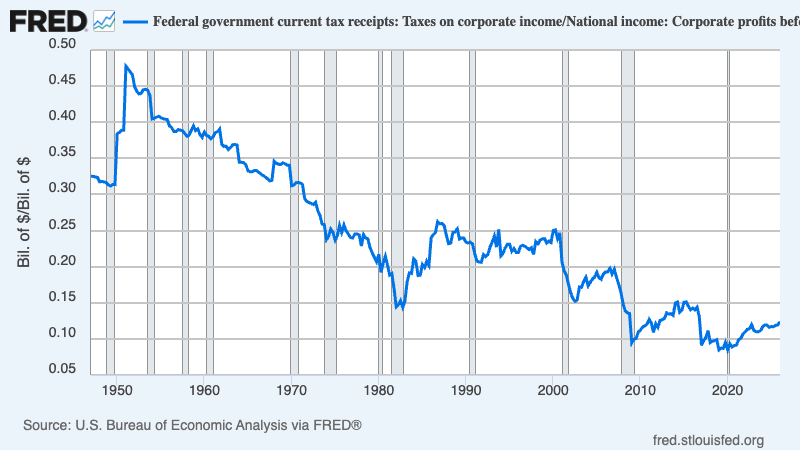
This massive decline in corporate taxation – from 35% in the 1960s to around 12% today -- benefits the people who own corporations. Not surprisingly, equity ownership is highly concentrated among the wealthy. The Distributional National Accounts produced by Gabriel Zucman and colleagues include an estimate of the effective federal tax rate on the top 0.01% of the income distribution, broken down by the kind of tax. They find a drastic decline in taxes at the top, mainly driven by the decline in corporate taxes:
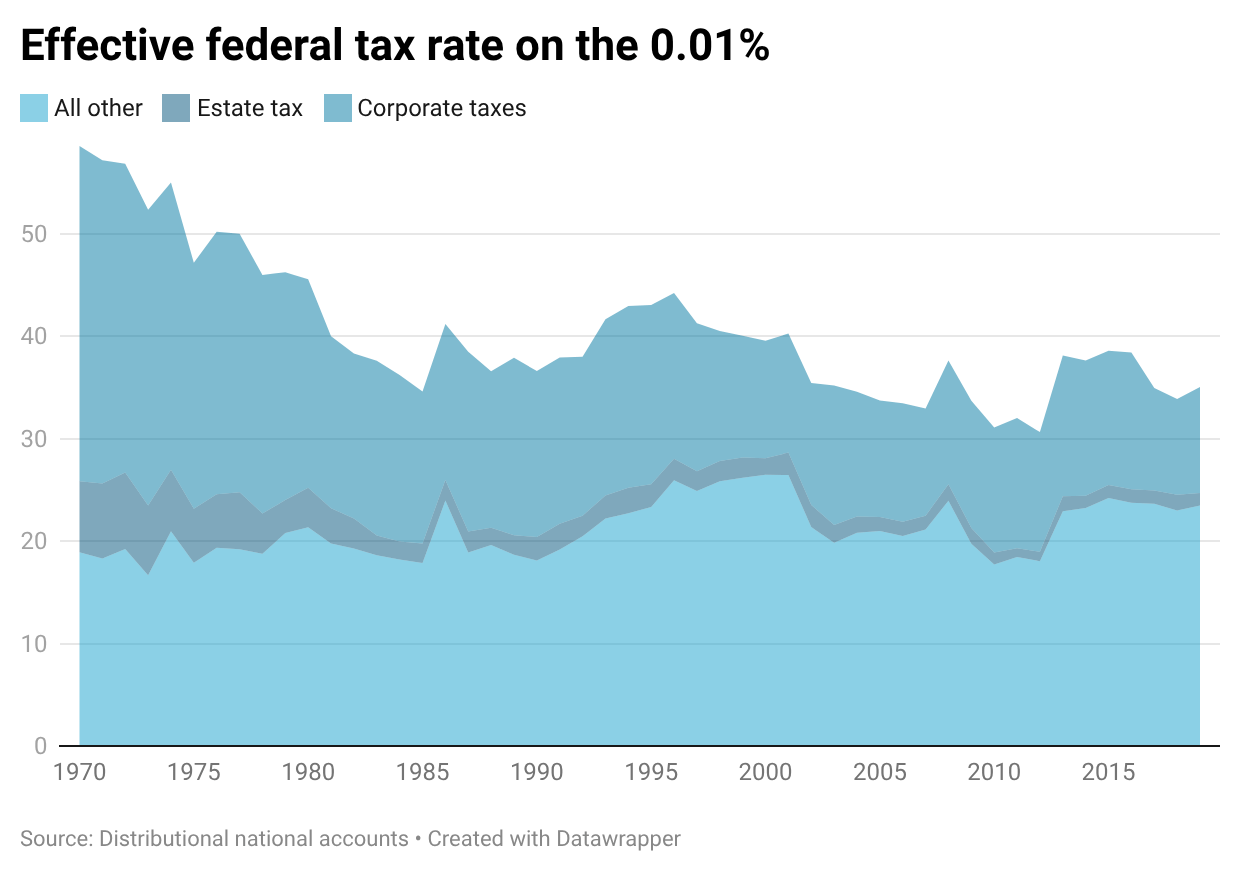
I should acknowledge that there is dispute both about just how much taxes for those at the top of the income distributionhave declined and about the sources of that decline, which largely rests on the question of the extent to which corporate tax cuts trickle down to workers and consumers. Zucman and colleagues assume very little trickle down. As I’ll explain in a moment, recent experience supports their view. But I should acknowledge that there is a dispute.
My main point, however, is that the big reductions in corporate taxes have taken place without broad public support — in fact, in the teeth of very broad public opposition.
Gallup has been surveying Americans about their views on taxes on a regular basis for more than 20 years. Public opinion on corporate taxes has barely changed over time. A huge majority consistently says that corporations pay too little, while hardly anyone says they pay too much:
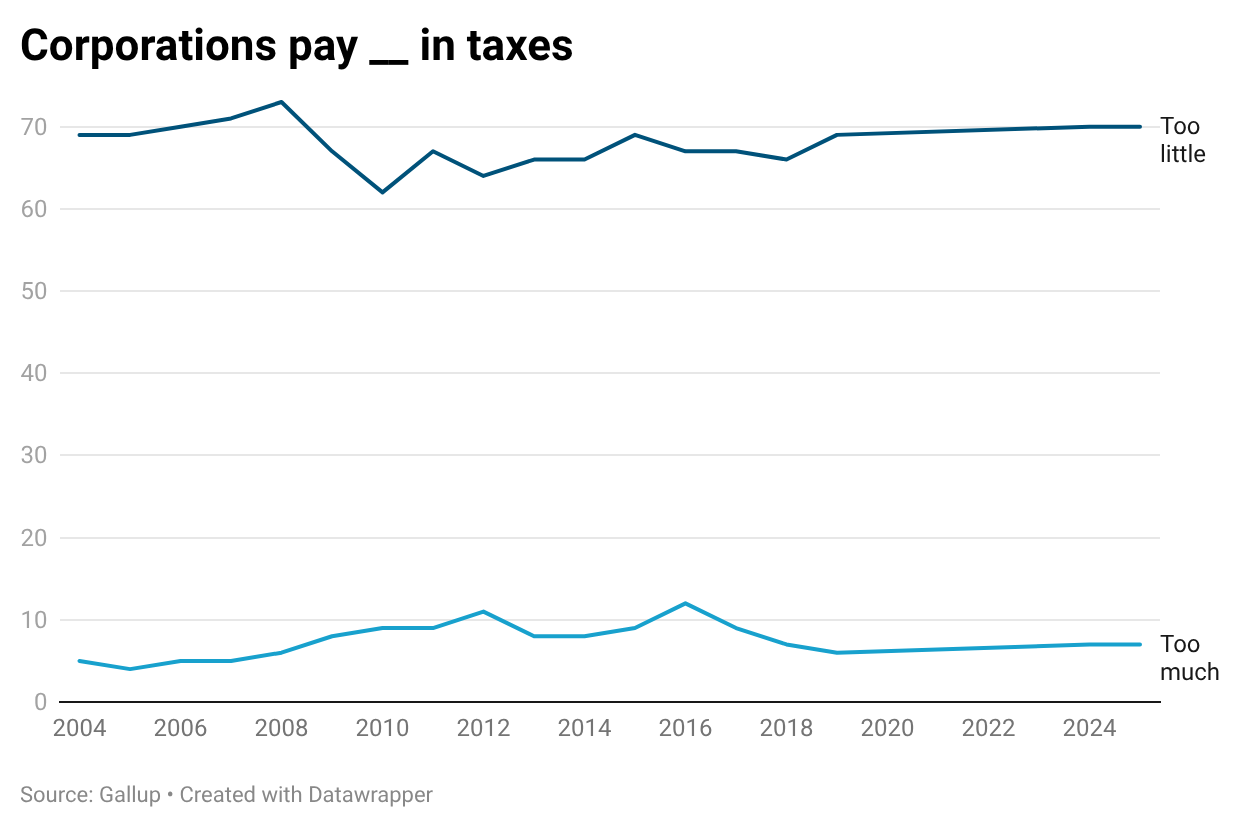
Americans, then, overwhelmingly believe that corporate taxes should go up — yet they keep going down. Why?
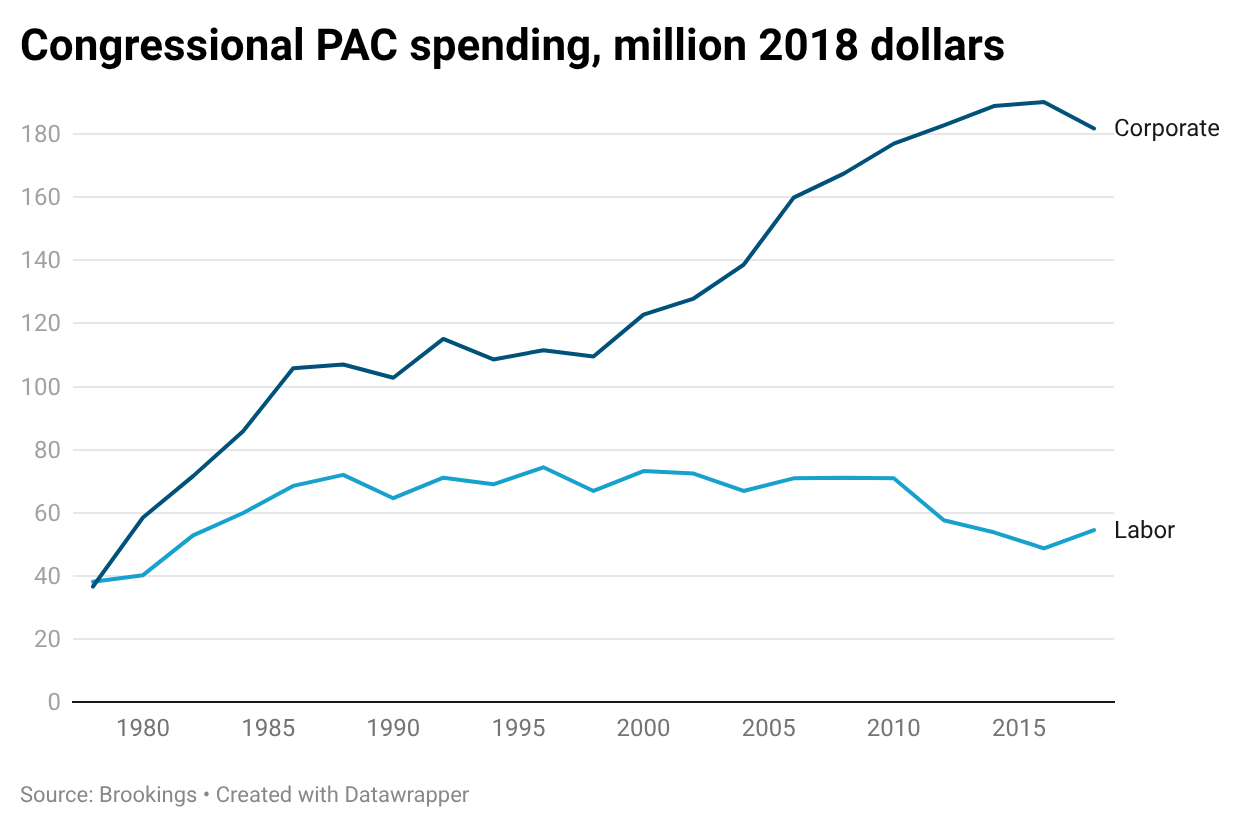
Part of the answer is campaign finance, which was increasingly dominated by the interests of capital even before Citizens United unleashed a tsunami of billionaire money:
Another part of the answer is corruption. Before Trump 2.0 political corruption was generally disguised and implicit: Politicians and political staffers favored corporate interests because of incentives like the revolving door, in which they could expect to move on to well-paid employment as lobbyists. These days, thanks to Trump, political graft is open and direct: much of it is simply cash, crypto and sweetheart contracts that enrich politicians and their families.
In addition, big money has gained the ability to shape the information environment. Right-wing think tanks, subsidized “research” and captured media relentlessly push the interests of billionaires. This shifts the Overton Window, the range of policies conventional wisdom considers acceptable: even centrists often end up viewing billionaire-friendly policies as sensible and reasonable, while other policies — even policies that were considered perfectly normal in the past, like high taxes on profits — are viewed as radical and irresponsible.
A key part of the argument that corporate taxes must be kept low is the claim that the United States is competing with other nations for a limited pool of global capital, and that if we have higher corporate taxes than other nations, the capital will go elsewhere. Correspondingly, advocates of further cuts in corporate taxes claim that such cuts will generate huge inflows of capital from abroad, leading to higher economic growth and wages for workers.
So it’s worth pointing out that Trump did, in fact, slash corporate taxes in 2017. What happened as a result? Basically, nothing, except that corporations paid even less in taxes.
True, some corporations revised their accounting fictions, reassigning some profits they had booked with subsidiaries in Ireland and other low-tax nations back to the parent company. But there was no huge surge in US investment.
This experience convinced me that there is very little trickle-down from corporate tax cuts. Thus the huge decline in corporate tax rates since 1970 was, in fact, a huge indirect tax cut for wealthy individuals who own lots of stock. And this, as I noted earlier, fueled America’s spiral into oligarchy, in which growing concentration of wealth at the top generates the resources to further tilt economic and political policies in their favor.
Is the system rigged? Yes, it is. Can we unrig it? Yes, we can. If you look back at the chart showing the downward trend in tax rate on the top 0.01%, you will see that there were significant although temporary reversals in that trend under both Bill Clinton and Barack Obama (reflecting, in Obama’s case, tax hikes to pay for expanded healthcare.) Right-wingers predicted disaster from these tax hikes, which never materialized.
What we need going forward is for voters to elect candidates who are committed to reversing the downward spiral of oligarchy. Realistically this means electing Democrats who are committed to raising taxes on the wealthy. Beyond that, it means rejecting Democrats — like, alas, Sen. Gillibrand of New York — who accept tainted corporate campaign funds and sweetheart perks bestowed on themselves and family members. Furthermore, once in power, Democrats must pass laws that stop lawmakers and their family members from engaging in corrupt enrichment.
Perhaps in a perverse way we can thank Trump: things are so nightmarishly bad that we may have the best chance in decades of finally breaking out of the oligarchy trap.
MUSICAL CODA
For no particular reason
Oligarchy = Fascism. Oligarchy is government by the selfish. Fascism is government by the vicious. Seems you can’t have one without the other.
The system is rigged for the rich in every way and always has been. It's the root structure of capitalism to keep the people poor and overworked for the rich by control of the land as a commodity instead of a right as evidenced by Daniel Shays and the Regulators waging a rebellion against the oligarchy, only to be put down ruthlessly by mercenaries from Boston at orders of Washington in 1787. Controlling land as a commodity keeps most people poor and paying for land access, either rent or mortgages plus taxes these days, thus keeping most people desperately selling labor to not go homeless, thus keeping supply of desperate labor sellers high, thus keeping the price of labor low, and it's an endless cycle of the many working for the few. This is the root that needs to be spoken, the unmentioned elephant in the room. After this, all Krugman says is spot-on.