
Bicentennial Memories
It was 50 years ago today

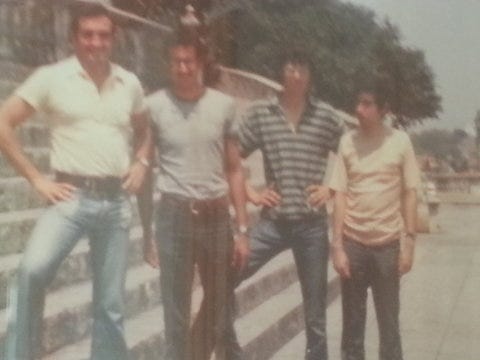
Lisbon 1976: Miguel Beleza, Andy Abel, Jeff Frankel, me
Today is the nation’s 250th anniversary. And it should be a day of celebration.
But it won’t be. America’s 250th birthday will be a grim, glum affair. As far as I can tell, even MAGA enthusiasts are feeling depressed. They certainly aren’t turning out to visit Donald Trump’s sad, shabby state fair.
It’s a huge difference from the bicentennial, which I celebrated in an unusual but deeply memorable way.
You see, I spent the summer of 1976 in Portugal, which had had its own revolution (the Carnation Revolution) just two years earlier. That revolution overthrew the nation’s fascist dictatorship and created what has proved an enduring democracy.
I was there as part of a group of MIT graduate students working at the Banco de Portugal — the country’s equivalent of the Federal Reserve. And I spent the 4th at a picnic in a Lisbon park, thrown by the U.S. embassy.
It was a small affair. These days Lisbon is overrun with American tourists and expats, but back then there were very few of us around. Even the U.S. government had relatively few people there, because it was trying to keep a low profile in the face of widespread anti-Americanism: Many Portuguese at the time were still talking about how the U.S. had helped overthrow a democratically elected government in Chile three years earlier. There were graffiti around Lisbon saying “Morte à CIA” — although some of these had had “e ao KGB” added in fresher paint.
So the embassy filled out the picnic by inviting Americans it knew were in Lisbon along with staff from other friendly embassies. I remember chatting with a number of West Germans.
The picnic was a charming affair. We stood around munching hot dogs — God knows how they managed that in the land of salt cod and grilled sardines — and listened as the ambassador read a patriotic message from Gerald Ford. And I remember feeling very good about America.
Furthermore, I wasn’t the only American feeling cheerful at the bicentennial, which was somehow an uplifting occasion.
This sunniness may seem odd, given that the U.S. was troubled in many ways. We had just suffered a humiliating defeat in Vietnam. Our cities were a mess: New York had 1600 murders in 1976, more than 5 times the rate last year, and Times Square was an eyesore of drug addicts and porn shops. Oh, and the city had recently gone bankrupt.
Yet somehow Americans managed to have fun at the bicentennial festivities, and there was a surprising amount of optimism in the air.
One source of optimism was surely the end of the Vietnam War. Yes, it ended in defeat. But it did end, which meant that young Americans and their families no longer had to worry about the draft, and that the nightly news didn’t keep reporting on body counts.
Another source of optimism — something people like JD Vance will never understand — was the fall of Richard Nixon. Satisfaction about how Watergate brought Nixon down wasn’t mainly about partisanship. Instead, the Watergate saga felt like an affirmation of the American spirit. Reporters were heroes and the media did its job. So did Congress. Nobody would call Gerald Ford a great president, but he was clearly a decent human being. The powerful were held accountable. America, it seemed, still retained its soul.
Who would say that now?
On the eve of America’s 250th birthday we had confirmation of presidential corruption on a scale Nixon could never have imagined. That’s bad in itself. What’s worse is that nobody believes that there will be any consequences for Trump, his cronies, and their henchmen. In 1974 Republicans joined with Democrats to hold Nixon accountable. This time around they’re fully invested in magnifying Trump’s power and his cult of personality, despite knowing perfectly well who he is and what he is doing.
I am not giving up hope. America is not irretrievably lost. But now, much more than 50 years ago, we are a nation in desperate need of redemption.
Why are we (and I’m not an American but the same is true in many places) choosing to live in hatred, bitterness, ignorance and misery when we could choose the opposite?
It’s surreal. A really strange world. For example I listen to all the reasons thrown out on why I should fear and hate Muslims: treat women badly, anti-science, want a theocracy, no freedom, intolerance and so on. Frankly among the Muslims I know that description doesn’t register, but there you go. The problem, though, is that the people putting out those reasons appear to want exactly what they are railing against.
It’s a real struggle to try to grasp any of this.
Thank you for your articles and optimism.